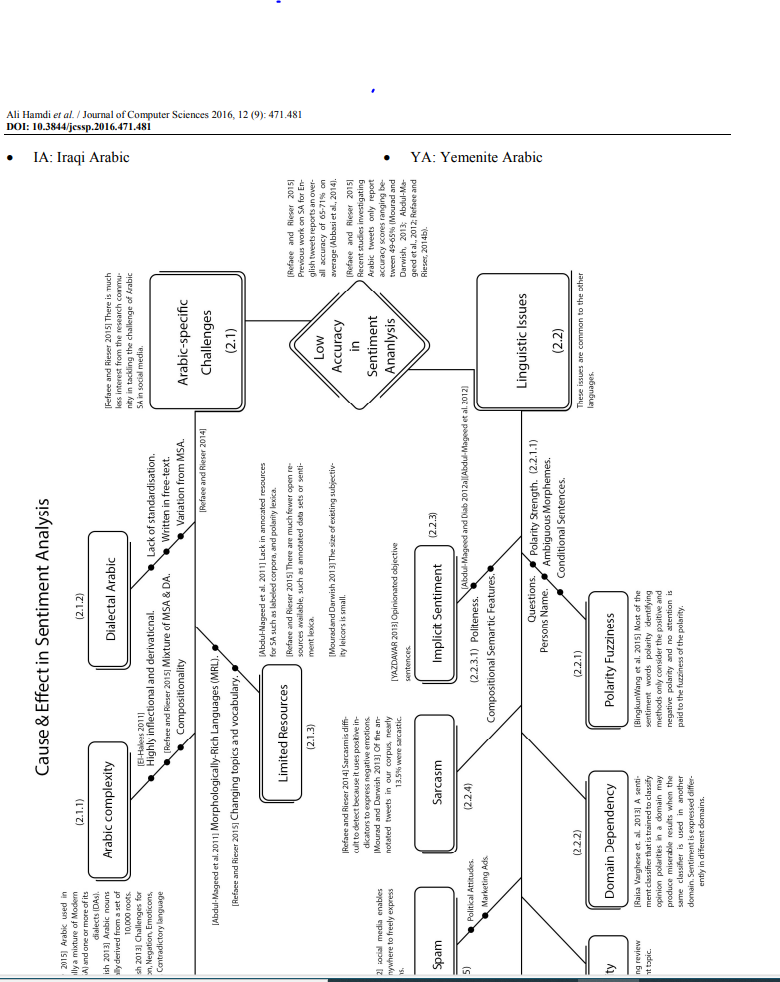

Arabic text sentiment analysis suffers from low accuracy due to Arabic-specific challenges (e.g., limited resources, morphological complexity, and dialects) and general linguistic issues (e.g., fuzziness, implicit sentiment, sarcasm, and spam). The limited resources problem requires efforts to build new and improved Arabic corpora and lexica. We propose a class-specific sentiment analysis (CLASENTI) framework. The framework includes a new annotation approach to build multi-faceted Arabic corpus and lexicon allowing for simultaneous annotation of different facets, including domains, dialects, linguistic issues, and polarity strengths. Each of these facets has multiple classes (e.g., the nine classes representing dialects found in the Arab world). The new corpus and lexicon annotations facilitate the development of new class-specific classification models and polarity strength calculation. For the new sentiment …